
SURABAYA, September 1, 2026 – The Faculty of Science and Technology (FST) Universitas Airlangga (UNAIR) successfully held the ICOMCOS 2026 Workshop on Tuesday (September 1, 2026). The workshop was part of The 4th International Conference on Mathematics, Computational Sciences, and Statistics (ICoMCoS) 2026.
The workshop carried the theme “Data-Driven Dynamic Modeling: Spatial, Temporal, and Approximation Perspectives.” The theme highlighted the role of data-driven dynamic modeling in addressing real-world problems through mathematical, computational, and statistical approaches.
The event also supported the achievement of the Sustainable Development Goals (SDGs). In particular, the workshop supported SDG 4 on Quality Education, SDG 9 on Industry, Innovation and Infrastructure, and SDG 17 on Partnerships for the Goals.
The workshop was held in a hybrid format from 9:00 a.m. to 3:00 p.m. Western Indonesia Time (WIB). Dozens of participants joined the event both in person in Surabaya and online. Through this activity, FST UNAIR expanded opportunities for knowledge sharing while strengthening international academic collaboration networks.
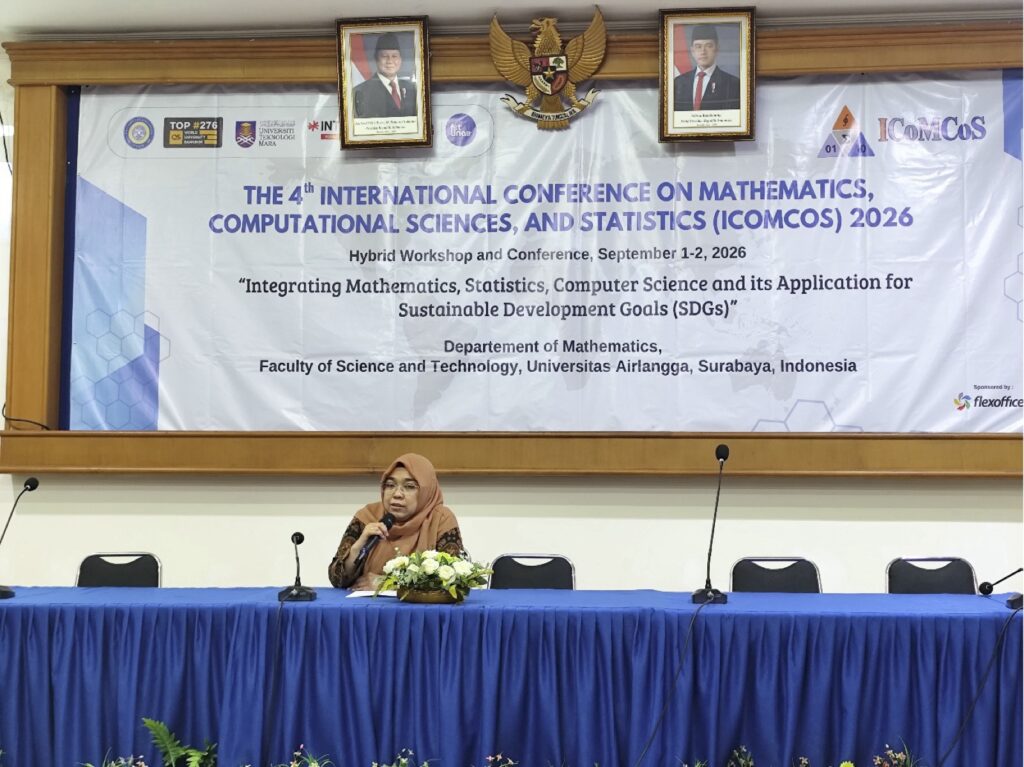
The committee invited three speakers from universities in the United States and Indonesia. They discussed four main topics related to epidemiological modeling, spatial statistics, and trajectory optimization.
Machine Learning for Hepatitis B and Measles Outbreak Modeling
The first session featured Dr. Chidozie Williams Chukwu from Georgia Southern University, United States. He delivered two presentations online.
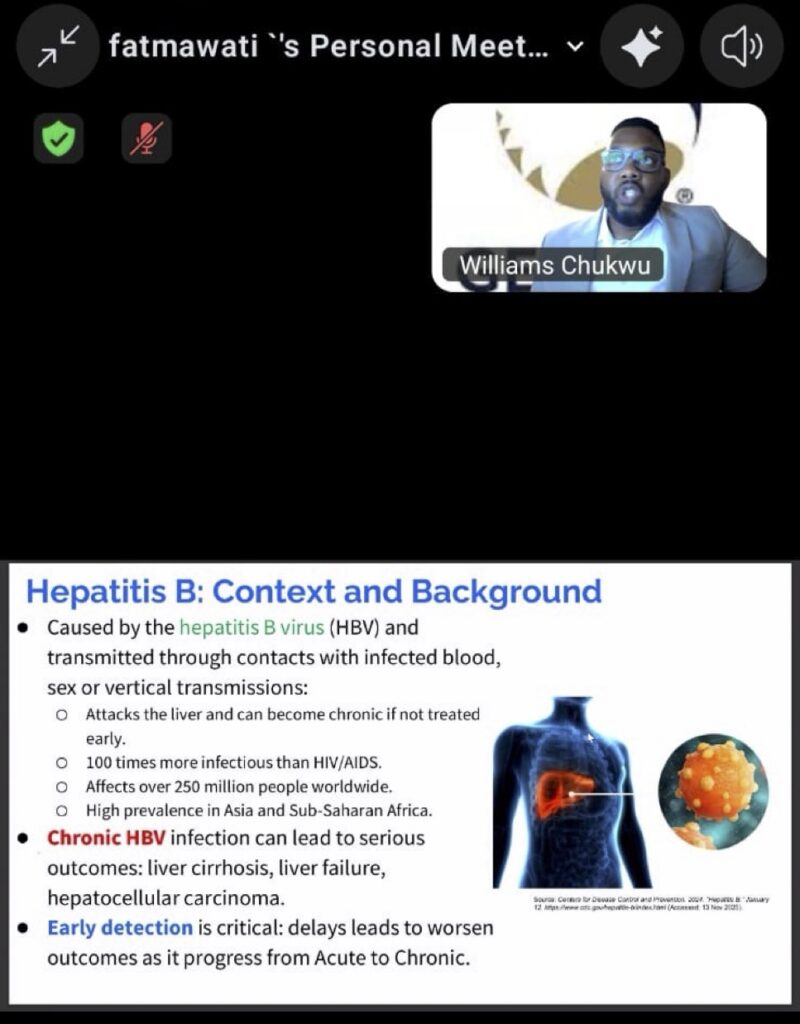
The first presentation was titled “From Data to Prediction: Machine Learning Approaches for Hepatitis B.” In this session, Dr. Chukwu explained the use of machine learning to support the early detection of Hepatitis B.
The model can also help predict patient clinical outcomes. Furthermore, he introduced the Shapley Additive exPlanations (SHAP) method to improve the interpretability of model results.
SHAP is an approach used in explainable artificial intelligence (XAI). The method helps identify the key clinical risk factors that influence a patient’s condition.
SHAP is an approach used in explainable artificial intelligence (XAI). The method helps identify the key clinical risk factors that influence a patient’s condition.
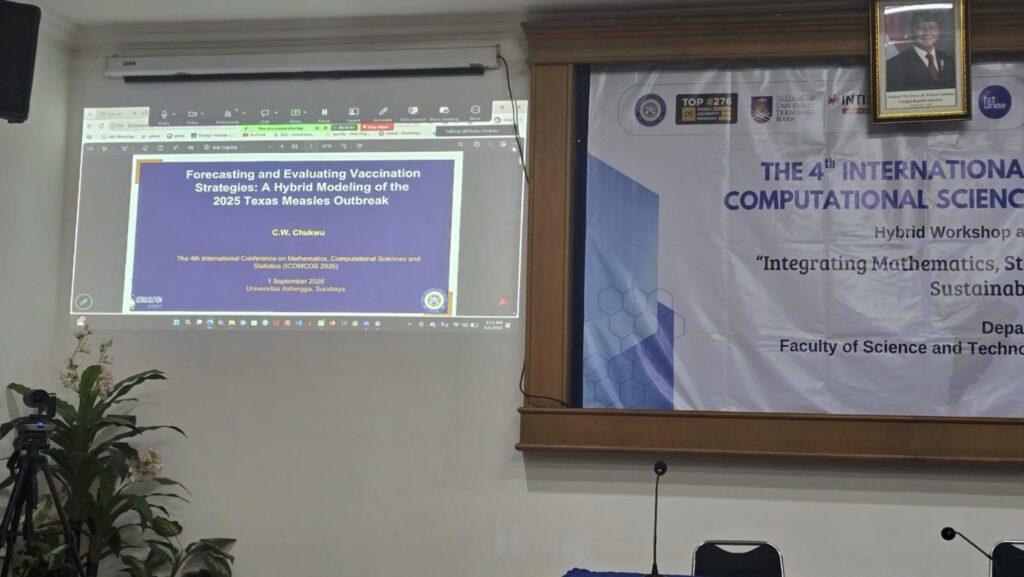
In this session, he explained the characteristics of measles infection and its transmission dynamics. He also introduced a hybrid mathematical model for analyzing outbreak transmission.
Through this model, participants learned about numerical simulation results and outbreak forecasting. The presentation also examined various vaccination strategy scenarios in Texas.
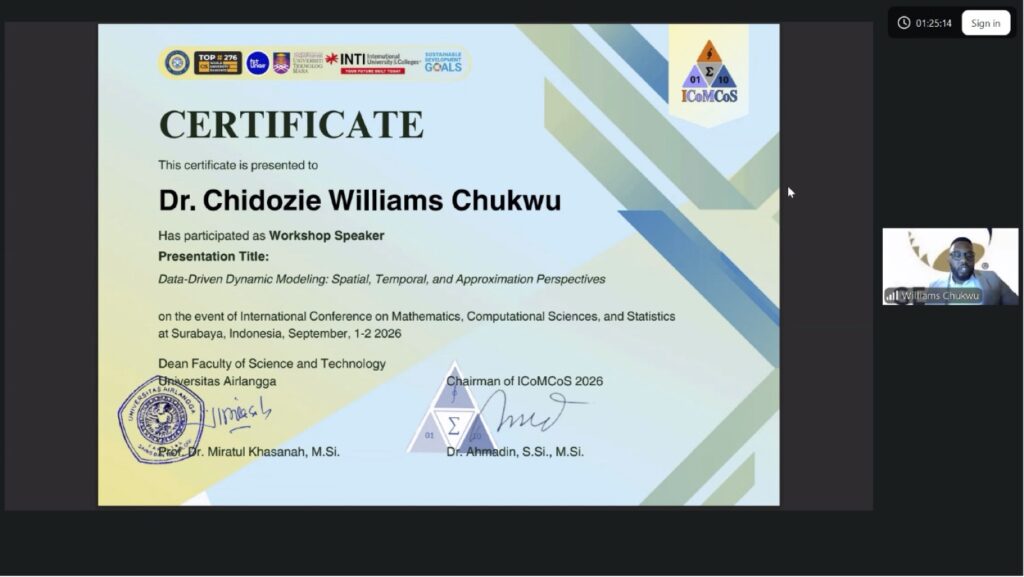
The first session concluded with the presentation of an appreciation certificate to Dr. Chidozie Williams Chukwu. A representative of the committee presented the certificate symbolically through the virtual session.
Spatial Statistics for Epidemiology and Ecology
The second session featured Prof. Folashade B. Agusto from the University of Kansas, United States. Prof. Agusto attended the workshop in person in Surabaya and delivered a presentation titled “Introduction to Spatial Statistics in Epidemiology and Ecology: From Linear Regression to Spatial Thinking.”
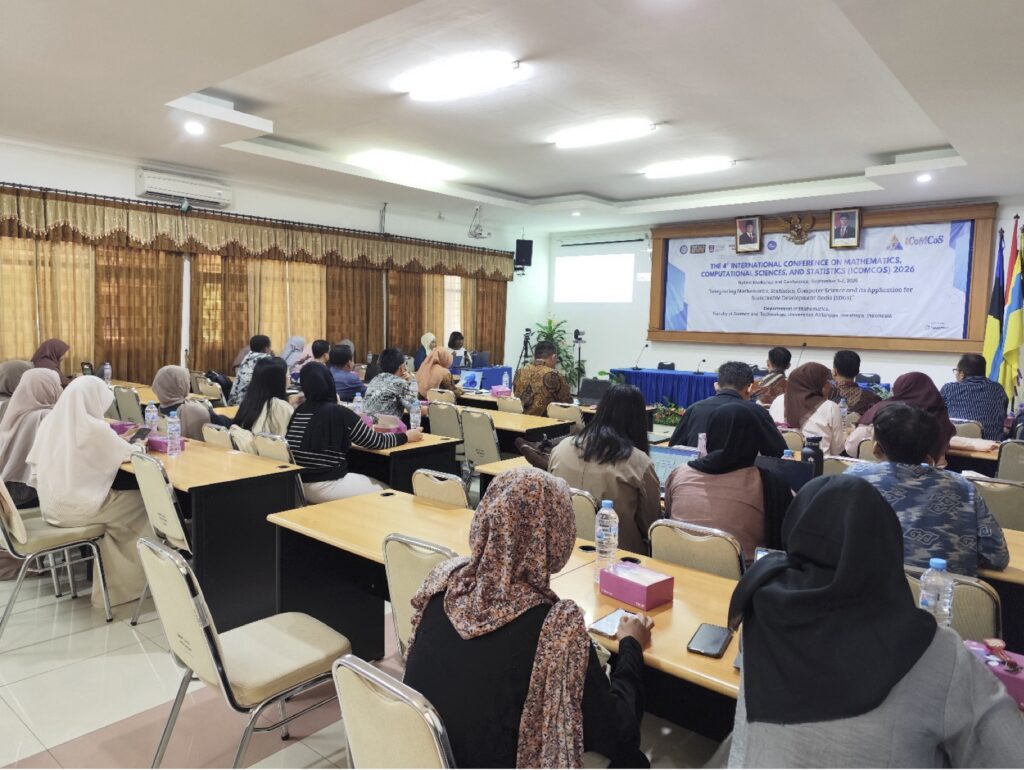
In her presentation, Prof. Agusto explained the challenges of spatial data analysis. One of these challenges concerns the classical regression assumption of independent observations.
This assumption is often not satisfied when researchers analyze spatial data. Therefore, understanding relationships between regions is an important part of spatial analysis.
Prof. Agusto also introduced several types of spatial data commonly used in epidemiological and ecological research. She then discussed the concept of spatial autocorrelation.
This concept helps researchers identify and measure patterns of relationships between regions. In addition, Prof. Agusto explained the use of a spatial weights matrix to represent neighborhood relationships between regions.
This concept helps researchers identify and measure patterns of relationships between regions. In addition, Prof. Agusto explained the use of a spatial weights matrix to represent neighborhood relationships between regions.
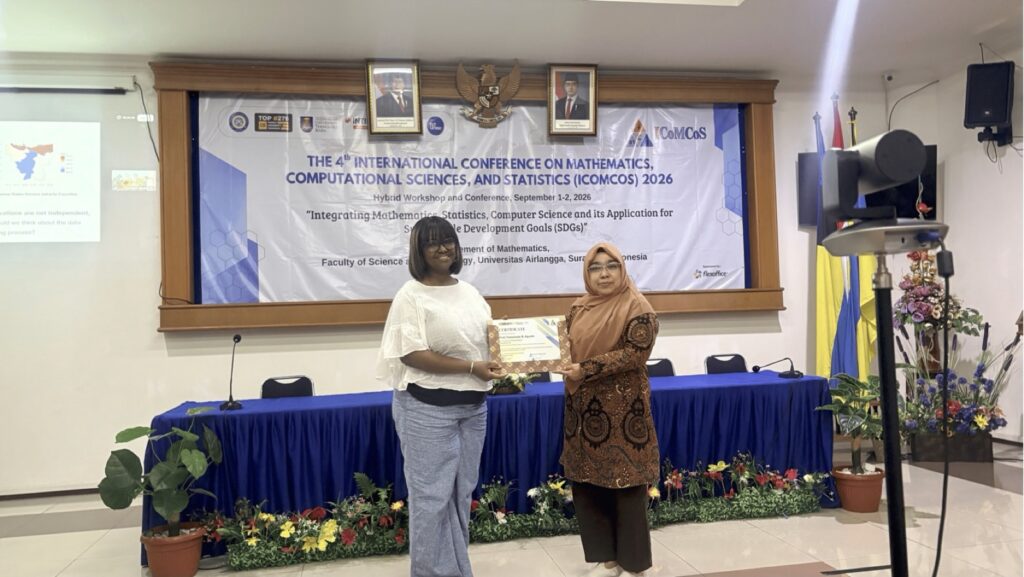
After the interactive question-and-answer session, Prof. Fatmawati, Vice Dean III of FST UNAIR, presented an appreciation certificate to Prof. Folashade B. Agusto. The certificate recognized her academic contribution to the workshop.
Trajectory Optimization for Strategic Applications
The third session served as the final main presentation. It featured an academic collaboration from Institut Teknologi Sepuluh Nopember (ITS), represented by Prof. Subchan, M.Sc., Ph.D. and Alvian Hidayatullah.
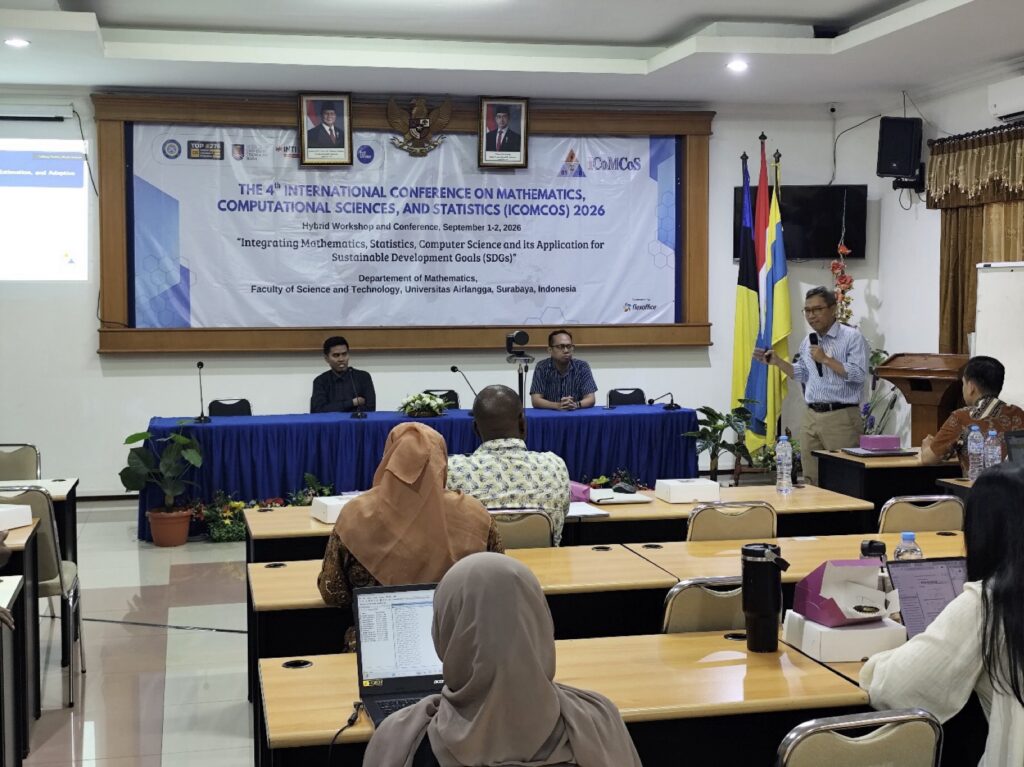
Both speakers attended the workshop in person and presented a topic titled “Trajectory Optimization: From Continuous Optimal Control to NLP, Dynamic Consistency Estimation, and Adaptive Mesh Refinement.”
Prof. Subchan opened the session by explaining the challenges of solving Continuous Optimal Control Problems (OCP) numerically.
These problems require specialized approaches because Nonlinear Programming (NLP) processes finite-dimensional vectors. In contrast, continuous optimal control problems involve continuous functions.
Prof. Subchan then guided participants through the mathematical transformation process using discretization. This process transforms a continuous problem into a Finite Nonlinear Programming (Finite NLP) problem that can be solved numerically.
The presentation went beyond theoretical concepts. It also demonstrated various applications of trajectory optimization in strategic sectors.
Examples included aerospace trajectory design, robotic motion planning, and energy storage management.
In addition, trajectory optimization can support epidemic control and the optimization of global economic dynamics. These examples demonstrate the broad applications of optimization methods in dynamic modeling.
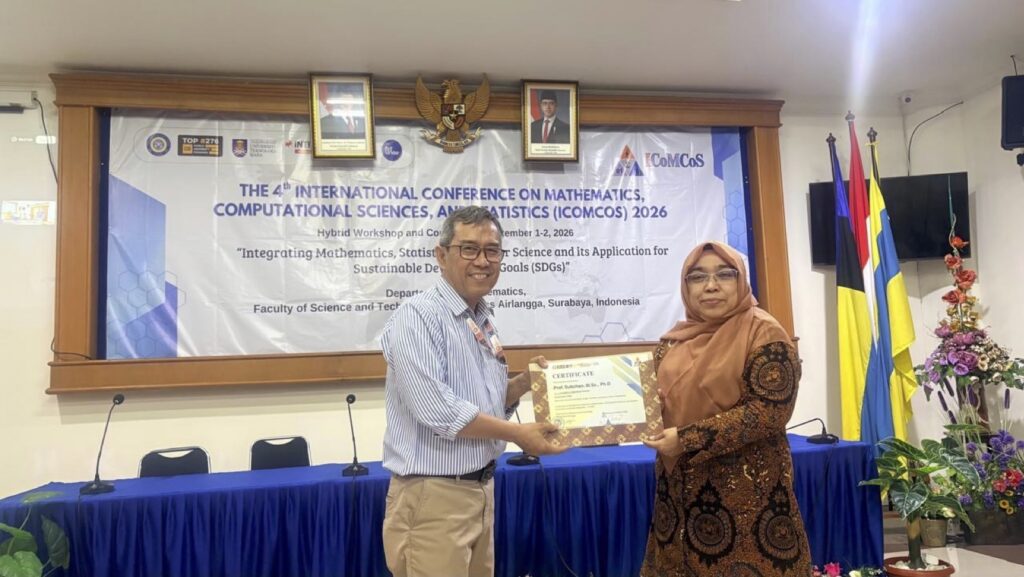
The final session concluded with the presentation of an appreciation certificate to Prof. Subchan. Prof. Fatmawati, Vice Dean III of FST UNAIR, presented the certificate as a form of appreciation.
Panel Discussion Integrates Dynamic Modeling Research
After all presentations had concluded, the workshop continued with a dynamic panel discussion. Participants actively engaged with the speakers to discuss opportunities for research integration.
The discussion provided new perspectives on the relationship between data-driven epidemiological modeling, spatial statistics, and trajectory optimization. These three approaches can complement one another in developing a more comprehensive dynamic modeling framework.
Through the ICOMCOS 2026 Workshop, FST UNAIR further strengthened its international research collaboration network. The event also brought together perspectives from mathematics, statistics, and computer science.
Such collaboration represents an important step toward advancing data-driven research. Furthermore, the workshop created opportunities for knowledge exchange and research development that can address a wide range of real-world challenges.
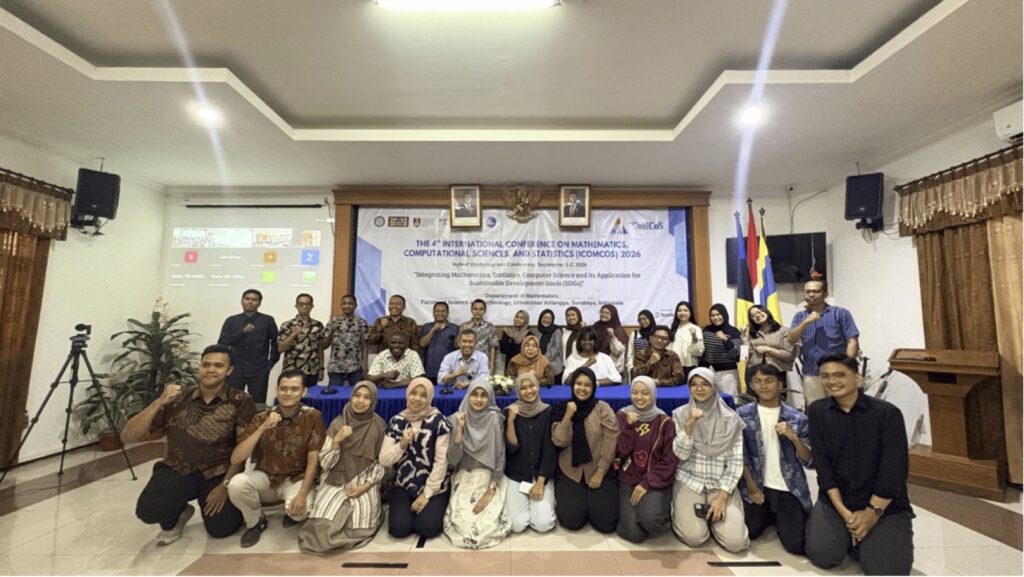
The event concluded with a group photo involving the speakers, committee members, and participants. The moment symbolized the success of cross-border academic collaboration through the ICOMCOS 2026 Workshop.